


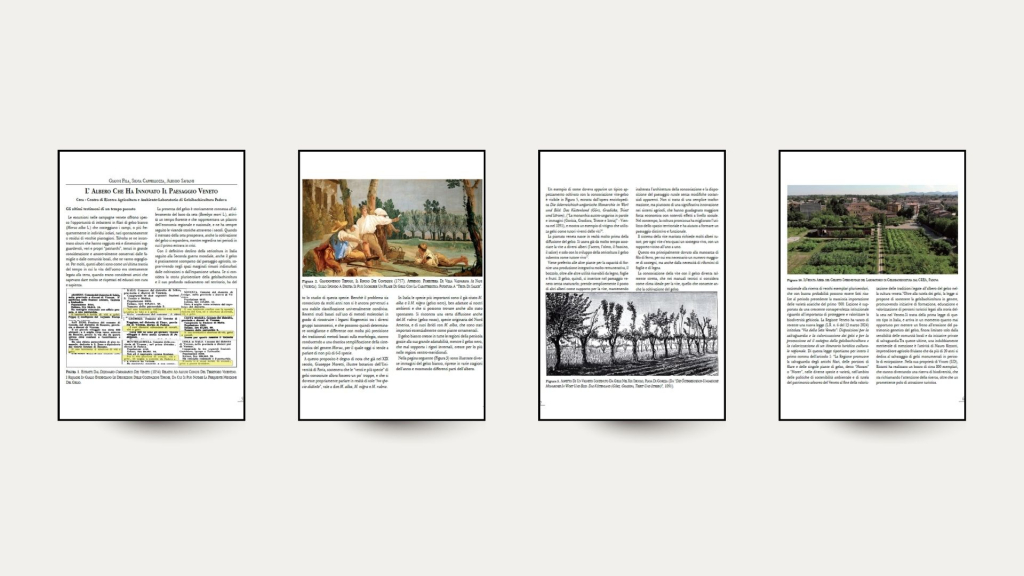
The chapter “L’albero che ha innovato il paesaggio veneto” (“The Tree that Innovated the Venetian Landscape”), authored by Gianni Fila, Silvia Cappellozza and Alessio Saviane, explores the historical diffusion of mulberry cultivation and its contribution to agricultural systems, territorial organization and socio-economic development in the Veneto region.
The spread of the white mulberry (Morus alba) in Italy dates back to the late Middle Ages, when the expansion of sericulture led to its systematic cultivation across northern regions. In Veneto in particular, the mulberry became a defining element of traditional polycultural farming systems, especially within the vine–mulberry association characteristic of the so-called piantata veneta, a land-use structure that shaped the visual and functional organization of the countryside for centuries.
Beyond its essential role in silkworm breeding, the mulberry tree represented a highly multifunctional agricultural resource. Its leaves were used as animal feed, its wood for tools and fuel, its bark for bindings, and its fruits for food production, making it a key component of resilient and self-sufficient rural economies. Until the early twentieth century, mulberry cultivation and sericulture remained among the pillars of agricultural production in northern Italy.
Following the decline of sericulture after the Second World War and the rise of intensive agricultural practices, mulberry trees gradually disappeared from large parts of the rural landscape. However, increasing attention to sustainability, biodiversity conservation and agroforestry systems has recently renewed interest in this species. Today, mulberry cultivation is being reconsidered for its potential contribution to climate mitigation, soil stabilization, ecosystem services and the diversification of agricultural production systems.
The chapter is published in the volume La seta nella Pedemontana Veneta: da Marco Polo ad oggi, edited by Maria Angela Cuman and Gianna Francesca Rodeghiero (Attilio Fraccaro Editore, 2024), which investigates the historical development of silk production and its cultural, economic and territorial impact in the Pedemontana Veneta area.
The full contribution is available in the book at the following link:
https://www.diestlibri.com/attiliofraccaroeditore/5904-la-seta-nella-pedemontana-veneta-da-marco-polo-ad-oggi.html