


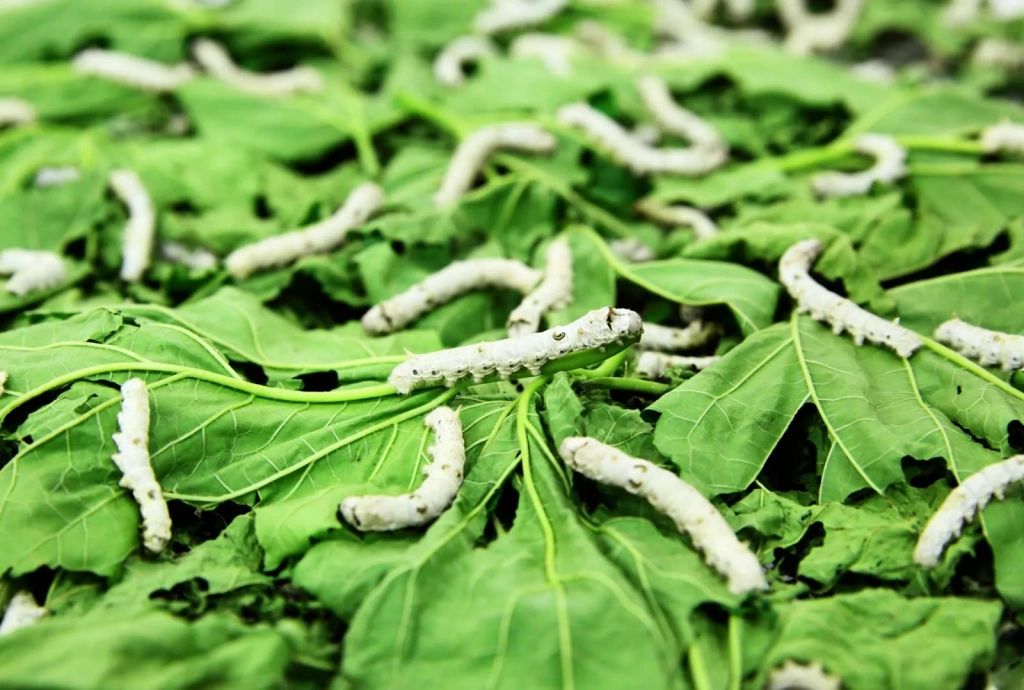
The article Old European Silkworm Breeds Reared in Early-20th-Century Bulgaria and Their Potential Use in Modern Sericulture recently published examines the historical role, biological characteristics, and contemporary relevance of traditional European silkworm breeds that were widely reared in Bulgaria from the late nineteenth century to the mid-twentieth century. The authors aim to show that, although these breeds are no longer competitive under modern industrial standards, they retain significant genetic, ecological, and cultural value and could play a role in future breeding programs and heritage-oriented sericulture.
The study begins with a detailed reconstruction of the history of Bulgarian sericulture. From 1895 until roughly 1960, Bulgarian sericulture relied mainly on two indigenous breeds: Yellow local and White Baghdad.
Drawing on archival experimental data from the 1920s and 1930s, the authors describe these old breeds as biologically robust but morphologically and technologically heterogeneous. Larval colour and markings varied greatly, and cocoon colour and shape were far from standardised. The cocoons were often relatively heavy, yet the proportion of silk shell and the length of the silk filament were low compared with modern standards. Despite these shortcomings, both Yellow local and White Baghdad displayed comparatively good tolerance to nuclear polyhedrosis virus (NPV) and were well adapted to local climatic conditions and mulberry varieties, having been maintained for generations in the same environments.
The article then connects these historical findings with contemporary experimental data. A substantial portion of the article is devoted to genetics and breeding theory, particularly the inheritance of qualitative traits such as larval markings, cocoon colour, and cocoon shape. This genetic background suggests that it is theoretically feasible to improve the quantitative productivity of old coloured-cocoon breeds through controlled crossbreeding with high-yield white-cocoon lines, while preserving their distinctive qualitative traits and adaptive advantages.
On this basis, the authors propose future research aimed at improving Yellow local through modern breeding strategies. The ultimate goal is not mass industrial replacement of modern hybrids, but rather the creation of improved lines that combine higher silk yield with disease resistance, local adaptability, and distinctive phenotypic traits.
Finally, the article situates this scientific work within a broader cultural and European framework, particularly through the ARACNE project. This initiative seeks to reconnect silk production with European cultural heritage by reintroducing local silkworm breeds for educational, artistic, and small-scale production purposes. In this perspective, old European silkworm breeds are seen not only as biological resources but also as carriers of historical identity and regional tradition. Through targeted genetic improvement and context-sensitive use, these breeds may still find a place in a diversified and sustainable future for European sericulture.